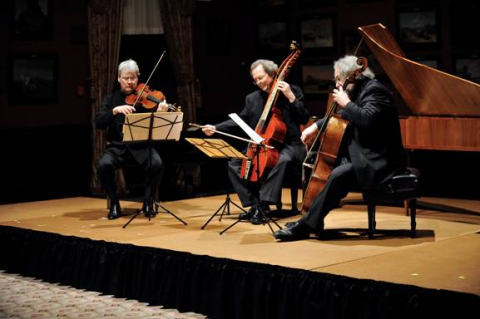
The Axelrod String Quartet
The Axelrod String Quartet—Marc Destrubé and Marilyn McDonald, violins; James Dunham, viola; Kenneth Slowik, violoncello—came into being in 1998 when Herbert and Evelyn Axelrod established a generous endowment to perpetuate string quartet performances at the museum using the quartets of instruments by master luthiers Antonio Stradivari, Nicoló Amati, and Jean-Baptiste Vuillaume which they had donated to the Smithsonian. But, since beginning with the time of Haydn, the string quartet has been a central formation of chamber music, a resident string quartet had already figured prominently in SCMS programming from 1982, when the Smithson String Quartet (Jaap Schröder and Marilyn McDonald, violins; Judson Griffin, viola; Kenneth Slowik, violoncello) was founded. That ensemble existed—with Jorrie Garrigue and David Cerutti replacing McDonald and Griffin late in its career—for fourteen years. It was succeeded by a somewhat ad hoc quartet called Party of Four (the immediate predecessor to the Axelrod Quartet), whose lower end was anchored by Slowik and violists Steven Dann and Douglas McNabney while a succession of players—Mayumi Seiler, Malcolm Lowe, Ian Swensen, and Catherine Manson—rotated between the violin chairs.
Central to the philosophy of each of these quartets has been the presence of gut strings, which were in regular use until at least several decades into the 20th century. This set-up, and the incorporation of other elements of the historical performance practices of a succession of periods from the High Classical through the early 20th century, has made elegance, clarity, and stylistic freshness hallmarks of SCMS quartet playing for nearly thirty years.
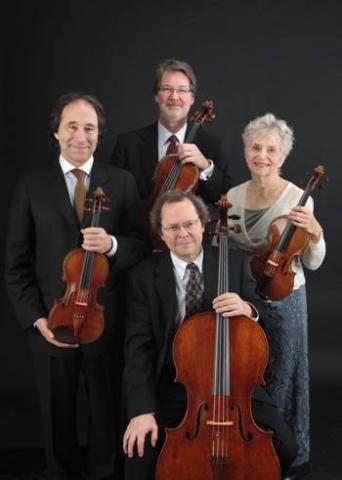
The Smithsonian Academy Orchestra
Founded in 2024, the Smithsonian Academy Orchestra is a project of the National Museum of American History in Washington, DC directed by Kenneth Slowik. Modeled after Frans Brüggen’s Orchestra of the Eighteenth Century, their repertoire ranges from Bach to Schoenberg performed on period instruments. This season you can hear them perform works by Haydn, Beethoven, Schumann and Brahms with performances in New York, Great Barrington, New Jersey, Philadelphia, and Washington DC! Please check for updates on the website as these concerts are scheduled separately from the SCMS concert series. SAO concerts are free and open to the public due to the generous support of The Honorable John FW Rogers and Goldman Sachs.
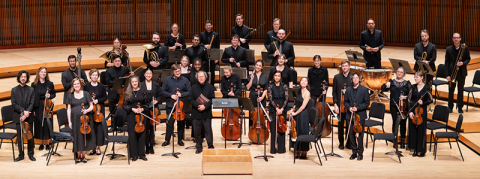
The Smithsonian Chamber Orchestra
The Smithsonian Chamber Orchestra was established in 1982 as a period-instrument ensemble for Viennese Classical-era music. Jaap Schröder conducted the orchestra from his concertmaster position through 1987, leading it in many concerts and in two major recording projects of works by Mozart and Beethoven. Kenneth Slowik became conductor in 1988, continuing the Beethoven symphony and piano concerto cycles. He also led Washington’s first historically-informed performances of the major Bach choral works, culminating in a recording of the St. John Passion, BWV 245, that was judged “unequivocally the best of the period instrument recordings” by the Cambridge Guide to Choral Music on Record. In the mid 1990s, Slowik and the Orchestra began to explore the repertoire and performance practices of the late 19th and early 20th centuries through works of Elgar, Schönberg, Mahler, Richard Strauss, and others. Recent productions have included works of Stravinsky, Copland, Bartók, and Shostakovich, all presented with intense focus on drawing the most rhetorically expressive performances from a group of dedicated and engaged musicians.
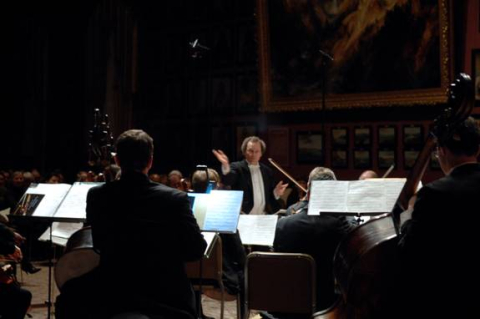
The Smithsonian Chamber Players
James Weaver, then a curator in the Division of Musical Instruments at the National Museum of History and Technology, established the Smithsonian Chamber Players in 1976. The group initially consisted of nine members, soprano Jean Hakes, wind players James Caldwell and Michael Seyfrit, violinists Marilyn McDonald and Mary Price, violist Melissa Graybeal, cellist Kenneth Slowik, bass player Thomas Wolf, and Weaver, who led the group from the harpsichord or fortepiano. From its very inception, the ensemble toured extensively under the auspices of the Smithsonian National Associates, presenting programs of music by Haydn, Mozart, Schubert, Vivaldi, Telemann, and Johann Sebastian, Johann Christian, and Johann Christoph Friedemann Bach.
Over the intervening years, the ensemble’s repertoire expanded in both chronological directions, reaching back into the sixteenth century and ahead to the mid-twentieth, including from 1993-95, the first period-instrument performance of the complete cycle of Brahms’s chamber music. The circle of performers was expanded to include European as well as American specialists, according to the repertoire chosen for a particular concert or recording, always comprising accomplished musicians who shared an expertise in and deep involvement with the music, instruments, and performance practices most appropriate to the works studied. Although SCMS has spawned several other successful ensembles, the Chamber Players remains an integral part of the Smithsonian Institution's pioneering role in the exploration of the rich cultural heritage of American music-making.
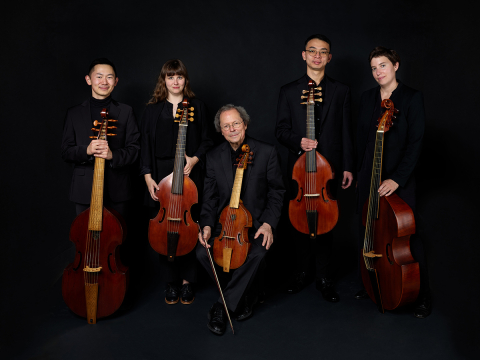
The Smithsonian Consort of Viols
Kenneth Slowik, Arnie Tanimoto, Wade Davis, Catherine Slowik, Chelsea Bernstein, and Lily Schrantz viols
Past Ensembles
The Castle Trio
Since 1984, the members of The Castle Trio (pianist Lambert Orkis, violinist Marilyn McDonald, and cellist Kenneth Slowik) have been performing together, on a range of appropriate “period” instruments, a repertoire that stretches from Haydn to Ives. Their concerts have been enjoyed by audiences across the United States and Canada, and in locations ranging from England and continental Europe to Central America.
The Castle Trio has recorded the complete trios of Beethoven, plus works of Schubert, Robert Schumann, Clara Schumann, Dvorak, and Smetana, for which it has received several awards and universal critical acclaim. Many of its performances have been distributed by National Public Radio, the BBC, and other international broadcast systems.
The BBC Record Review captured the essence of the Castle Trio’s success then it opined: “This is a trio of real virtuoso players who savor the sonority of the old instruments and who play beautifully together.”
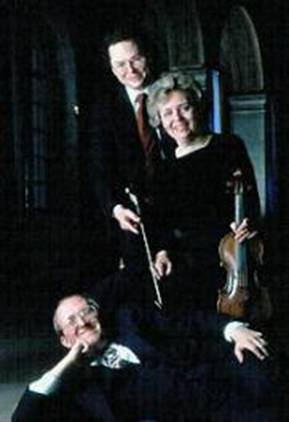
The Esterházy Machine
The Esterházy Machine—Kenneth Slowik, baryton and fortepiano; Steven Dann, viola and violin; Myron Lutzke, violoncello—takes its name from a casual remark made by Dutch cellist Anner Bylsma, who referred to the baryton, favorite instrument of Joseph Haydn’s employer Prince Nikolaus Esterházy “the Magnificent,” as “that Esterházy machine.” With six bowed strings and nine sympathetic strings (which may also be plucked by the left thumb), the baryton is indeed an unwieldy-looking instrument that might have fallen into eternal oblivion at the end of the 1800s but for the fact that Haydn wrote nearly 200 pieces for it. In its baryton—viola—cello formation, the Esterházy Machine addresses this sonically unique repertoire, while its violin—cello—fortepiano configuration allows it to play the rich keyboard trio repertoire of Haydn, Mozart, and their contemporaries.